Fanorona : comment jouer, étape par étape
Le fanorona est le jeu de plateau national de Madagascar : un jeu à deux joueurs sur un plateau de 9×5 où l'on capture les pions de l'adversaire. Selon la tradition, il s'est répandu vers le XVIIᵉ siècle, à l'époque du roi Ralambo, et on y joue encore dans les rues, les parcs et les maisons de toute l'île. Ce guide l'explique une idée à la fois, avec des images. Lisez les étapes dans l'ordre.
Les pions clairs sont les Blancs (les Blancs jouent en premier). Les pions foncés sont les Noirs. Un cercle rouge en pointillés avec × est un pion qui est capturé. Un cercle marron en pointillés indique l'endroit où se trouvait un pion. Les flèches vertes sont les déplacements ; les anneaux orange et bleus marquent les pions capturés.
1Le plateau
Le plateau compte 9 colonnes et 5 rangées. Les pions se posent sur les points où les lignes se croisent (45 points au total), et non dans des cases. Les lignes suivent les rangées et les colonnes, et les diagonales passent par un point sur deux.
2La position de départ
Chaque joueur a 22 pions. Les deux rangées les plus proches de chaque joueur sont pleines. La rangée du milieu alterne pions clairs et foncés, et seul le point central est vide. Les Blancs jouent en premier, depuis le bas.
3Déplacer un pion
À votre tour, vous déplacez un pion d'un pas, le long d'une ligne, vers un point vide voisin. Un pion ne saute jamais par-dessus d'autres pions.
4Capturer par approche
C'est aussi en se déplaçant que l'on capture. Approche : vous avancez vers un pion adverse, de sorte qu'après votre pas, un pion adverse se trouve sur le point suivant dans la même direction. Vous le capturez.
Pas seulement un pion : tous les pions adverses alignés sans interruption derrière lui sont capturés aussi. Cela fonctionne aussi sur les lignes diagonales :
5Capturer par retrait
Retrait : vous vous éloignez d'un pion adverse. Si un pion adverse se trouve juste derrière le point que vous quittez (du côté opposé à votre direction), vous le capturez.
6Combien de pions sont pris ?
La ligne capturée se poursuit tant qu'il y a des pions adverses alignés sans interruption. Elle s'arrête à un point vide, à l'un de vos propres pions, ou au bord du plateau.
7Approche ou retrait : à vous de choisir
Parfois, le même pas peut être une approche ou un retrait. Vous choisissez alors lequel jouer.
8La capture est obligatoire
La capture est obligatoire. Si l'un de vos pions peut capturer, vous devez jouer une capture. Vous pouvez choisir laquelle.
À cause de cette règle, le premier coup de la partie est toujours une capture. Les Blancs ont exactement 5 premiers coups possibles :
9Captures en chaîne
Après une capture, le même pion peut capturer à nouveau pendant le même tour. Vous pouvez vous arrêter quand vous voulez, mais vous ne pouvez pas changer de pion.
Deux restrictions s'appliquent dans une chaîne :
10Aucune capture possible ? Un coup simple (paika)
Seulement si aucun de vos pions ne peut capturer, vous jouez un déplacement ordinaire d'un pas, sans capture. On l'appelle un coup paika.
11Fin de la partie
Vous gagnez en capturant tous les pions de votre adversaire (ou si votre adversaire n'a aucun coup légal).
Match nul : sur ce site, s'il n'y a aucune capture pendant 10 coups de chaque joueur, la partie est nulle. (Avec un jeu parfait des deux côtés, le fanorona est nul, comme des ordinateurs l'ont démontré en 2008.) Vous pouvez aussi abandonner à tout moment.
12Jouer sur ce site
Voici ce que vous faites à l'écran. (Les captures d'écran ci-dessous sont en anglais ; vous pouvez choisir le français, l'anglais ou le malgache avec les boutons en haut du jeu.)
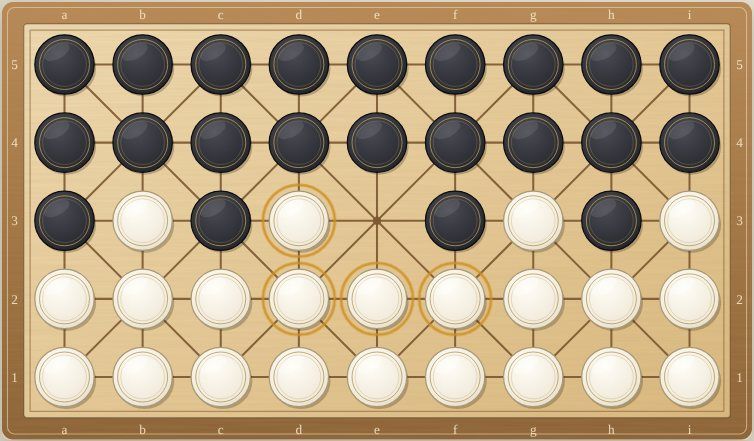
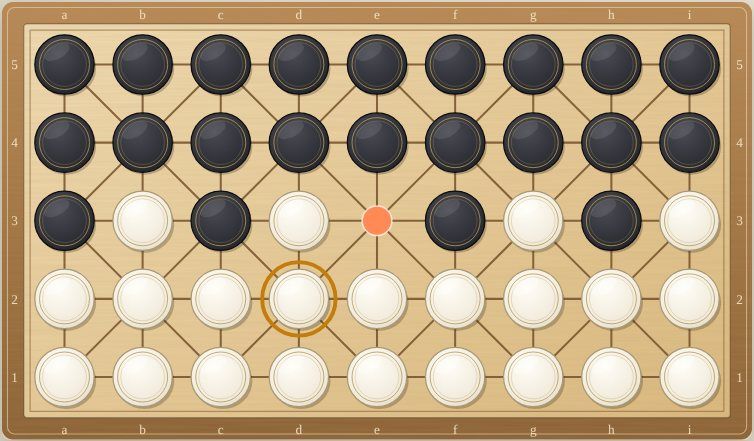
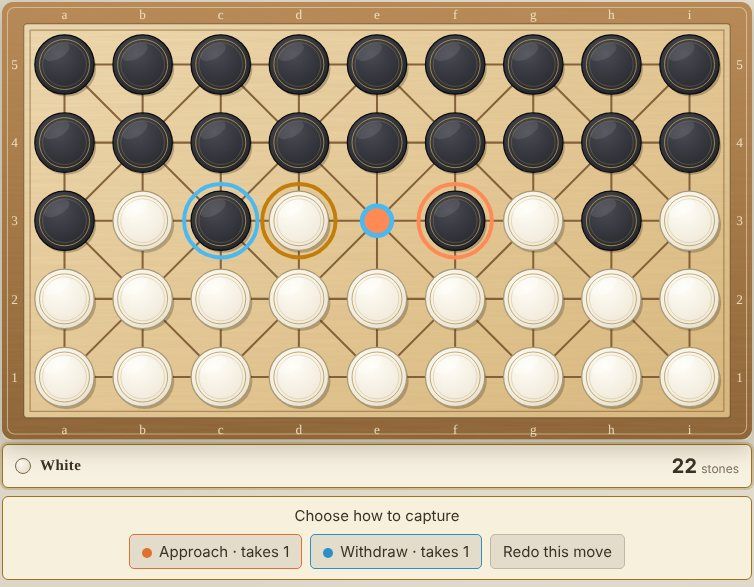
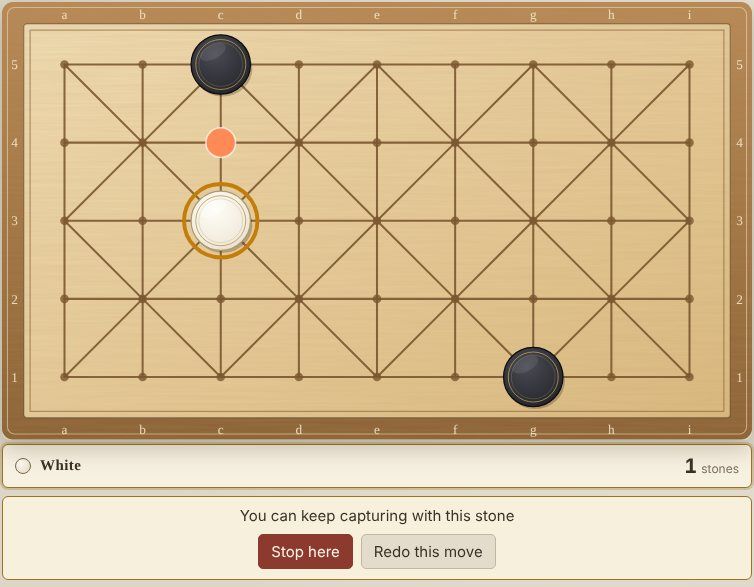
- L'ordinateur attend 2 à 3 secondes avant de répondre, pour que vous puissiez suivre la partie. Vous pouvez le modifier dans l'onglet « Partie ».
- Dans la liste des coups, A = capture par approche, W = capture par retrait (withdrawal), et le nombre indique combien de pions ont été pris. Les colonnes vont de a à i et les rangées de 1 à 5, comptées depuis le côté des Blancs.
- Utilisez Indice si vous êtes bloqué, et Annuler pour reprendre un coup.
13Conseils pour les débutants
- Cherchez les coups qui prennent une longue ligne de pions, puis vérifiez ce que votre adversaire peut reprendre.
- Comme la capture est obligatoire, vous pouvez sacrifier un pion pour forcer votre adversaire à faire une mauvaise capture.
- Les pions sur les points dorés peuvent aller dans plus de directions.
- Ne laissez pas une longue rangée de vos propres pions face à un point vide : une seule capture peut tous les prendre.
- Une chaîne de captures peut changer toute la partie en un seul tour : anticipez.
Fanorona: how to play, step by step
Fanorona is the national board game of Madagascar: a two-player game on a 9×5 board where you capture your opponent's stones. Tradition says it spread around the 17th century, in the time of King Ralambo, and it is still played in streets, parks and homes across the island. This guide explains it one idea at a time, with pictures. Read the steps in order.
Light stones are White (White moves first). Dark stones are Black. A red dashed circle with × is a stone that gets captured. A dashed brown circle shows where a stone used to stand. Green arrows are moves; orange and blue rings mark the stones that are captured.
1The board
The board has 9 columns and 5 rows. Stones stand on the points where lines cross (45 points in all), not inside squares. Lines run along rows and columns, and diagonal lines pass through every other point.
2The starting position
Each player has 22 stones. The two rows nearest to each player are full. The middle row alternates light and dark stones, and only the centre point is empty. White moves first, from the bottom.
3Moving a stone
On your turn you move one stone, one step, along a line, to an empty point next to it. A stone never jumps over other stones.
4Capturing by approach
Moving is also how you capture. Approach: you step toward an enemy stone, so that after your step an enemy stone is on the very next point in the same direction. You capture it.
Not only one stone: all enemy stones in an unbroken line behind it are captured as well. This also works on diagonal lines:
5Capturing by withdrawal
Withdrawal: you step away from an enemy stone. If an enemy stone stands directly behind the point you left (the opposite side of your direction), you capture it.
6How many stones are taken?
The captured line goes on as long as the stones are enemy stones in an unbroken line. It stops at an empty point, at one of your own stones, or at the edge of the board.
7Approach or withdrawal: your choice
Sometimes the same step could be an approach or a withdrawal. Then you choose which one to play.
8You must capture
Capturing is compulsory. If any of your stones can capture, you must make a capturing move. You may choose which one.
Because of this rule, the first move of the game is always a capture. White has exactly 5 possible first moves:
9Chain captures
After a capture, the same stone may capture again in the same turn. You can stop whenever you like, but you cannot switch to another stone.
Two restrictions apply inside a chain:
10No capture possible? A plain move (paika)
Only when none of your stones can capture, you make an ordinary move of one step without capturing. This is called a paika move.
11How the game ends
You win by capturing all of your opponent's stones (or if your opponent has no legal move).
Draw: on this site, if there is no capture for 10 moves by each player, the game is drawn. (With perfect play from both sides, Fanorona is a draw, as computers proved in 2008.) You may also resign at any time.
12Playing on this site
Here is what you do on screen.
- The computer waits 2–3 seconds before replying, so you can follow the game. You can change this in the Game tab.
- In the move list, A = approach capture, W = withdrawal capture, and the number is how many stones were taken. Columns are a–i and rows are 1–5, counted from White's side.
- Use Hint if you are stuck, and Undo to take a move back.
13Tips for beginners
- Look for moves that take a long line of stones, then check what your opponent can capture back.
- Because capturing is compulsory, you can sacrifice one stone to force your opponent into a bad capture.
- Stones on gold points can move in more directions.
- Do not leave a long row of your own stones facing an empty point: one capture can take them all.
- A chain of captures can change the whole game in one turn, so look ahead.
Fanorona: ny fomba filalaovana, dingana isan-dingana
Ny Fanorona dia lalao nentim-paharazana eto Madagasikara: lalao ho an'ny mpilalao roa amin'ny sehatra 9×5, izay maka ny vato an'ny mpifanandrina ny tsirairay. Araka ny fomban-drazana dia niely izy tokony ho tamin'ny taonjato faha-17, tamin'ny andron'i Ralambo, ary mbola lalaina any an-tanàna, ao an-tokotany ary any an-trano ankehitriny. Ity torolàlana ity dia manazava ny lalao hevitra iray isaky ny dingana, amin'ny sary. Vakio araka ny filaharana ny dingana.
Ny vato mazava dia an'ny Fotsy (izy no manomboka). Ny vato maizina dia an'ny Mainty. Ny boribory mena tapaka misy × dia vato alaina. Ny boribory volon-tany tapaka dia toerana nisy vato. Ny zana-tsipìka maitso dia hetsika; ny peratra oranjy sy manga dia manondro ny vato alaina.
1Ny sehatra
Misy tsanganana 9 sy andalana 5 ny sehatra. Ny vato dia apetraka eo amin'ny teboka (fihaonan'ny tsipika), izany hoe 45 no izy rehetra, fa tsy ao anatin'ny efa-joro. Misy tsipika mitsangana sy mitsivalana, ary misy tsipika miolakolaka eo amin'ny teboka iray mandingana iray fotsiny.
2Ny toerana fanombohana
Samy manana vato 22 ny mpilalao. Feno ny andalana roa akaikin'ny tsirairay. Ny andalana afovoany dia mifandimby vato mazava sy maizina, ary ny teboka afovoany ihany no malalaka. Ny Fotsy no manomboka, avy any ambany.
3Ny fampihetsehana vato
Amin'ny fotoanao dia mamindra vato iray, dingana iray ianao, amin'ny tsipika, mankany amin'ny teboka malalaka eo akaikiny. Tsy mitsambikina ny vato.
4Fakana amin’ny fanakaikezana
Ny fihetsehana ihany koa no fomba fakana. Manakaiky: mandroso mankany amin'ny vato an'ny mpifanandrina ianao, ka aorian'ny dingana nataonao dia eo amin'ny teboka manaraka mivantana, amin'ny lalana iray ihany, ny vato an'ny mpifanandrina. Alainao izany.
Tsy ny vato voalohany ihany: alaina daholo ny vato an'ny mpifanandrina rehetra mifanesy eo amin'io tsipika io. Mety amin'ny tsipika miolakolaka koa izany:
5Fakana amin’ny fialana
Miala: miala amin'ny vato an'ny mpifanandrina ianao. Raha misy vato an'ny mpifanandrina eo ambadiky mivantana ny teboka nialanao (mifanohitra amin'ny lalana nalehanao), dia alainao izany.
6Vato firy no alaina?
Mitohy ny fakana raha mbola vato an'ny mpifanandrina mifanesy no misy. Mijanona izy rehefa tonga amin'ny teboka malalaka, vatonao, na ny sisin'ny sehatra.
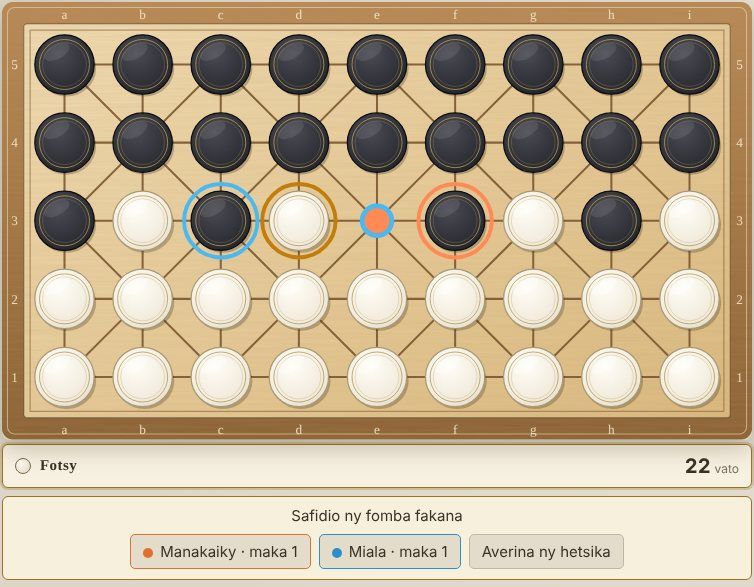
7Manakaiky na miala: ianao no misafidy
Indraindray ny dingana iray ihany dia mety ho fanakaikezana na fialana. Amin'izay dia misafidy ianao.
8Tsy maintsy maka
Tsy maintsy maka raha afaka maka. Raha misy vatonao afaka maka, dia tsy maintsy manao hetsika fakana ianao. Ianao no misafidy hoe iza.
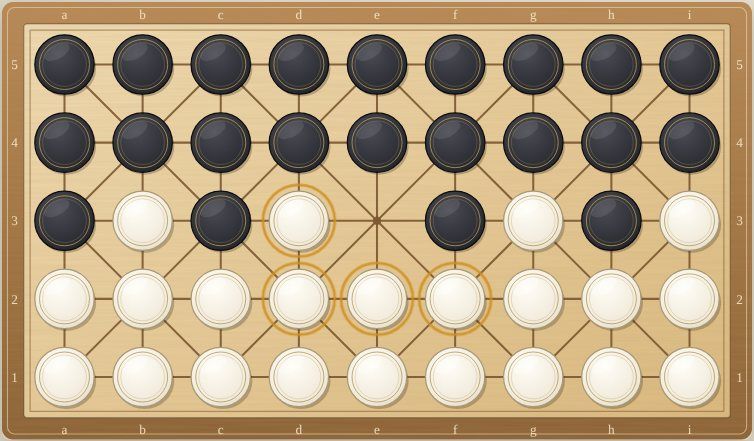
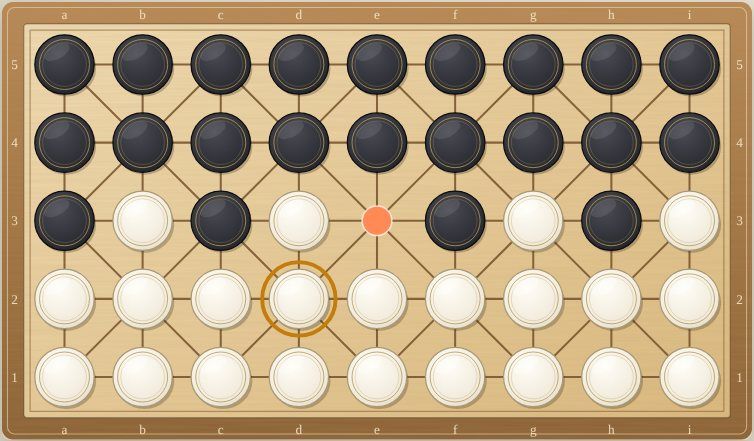
Noho izany lalàna izany, fakana foana ny hetsika voalohany amin'ny lalao. Misy hetsika voalohany 5 ihany ho an'ny Fotsy:
9Fakana misesy
Aorian'ny fakana, ny vato iray ihany dia mety hamaky indray amin'ny fotoana iray ihany. Afaka mijanona ianao rehefa tianao, saingy tsy azo ovaina ny vato.
Misy fameperana roa ao anatin'ny fakana misesy:
10Raha tsy misy azo alaina: Paika
Raha tsy misy vatonao afaka maka ihany vao azo atao ny hetsika tsotra dingana iray tsy maka. Ny hoe paika no antsoina izany.
11Ny famaranana
Mandresy ianao rehefa azonao ny vato rehetra an'ny mpifanandrina (na raha tsy afaka mihetsika izy).
Mitovy isa: eto amin'ity tranokala ity, raha tsy misy fakana nandritra ny hetsika 10 tsirairay dia mitovy isa. (Raha tsara lalao ny roa tonta dia mitovy isa ny Fanorona, araka ny nanaporofoan'ny solosaina azy tamin'ny 2008.) Afaka manaiky resy ianao amin'ny fotoana rehetra.
12Ny fampiasana eto amin'ity tranokala ity
Ireto ny ataonao eo amin'ny efijery.
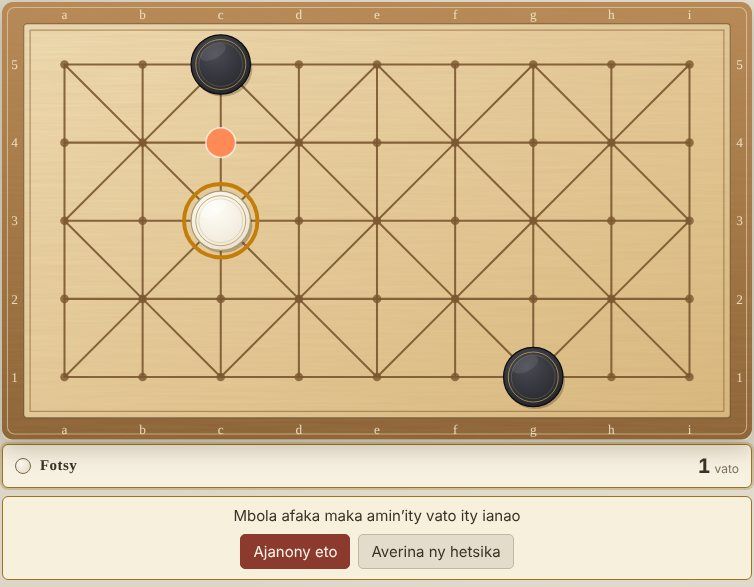
- Miandry 2–3 segondra ny solosaina alohan'ny hihetsika, mba ho hitanao ny lalao. Azo ovaina ao amin'ny tabilao “Lalao”.
- Ao amin'ny lisitry ny hetsika, A = fakana amin'ny fanakaikezana, W = fakana amin'ny fialana, ary ny isa dia ny vato nalaina. Ny tsanganana dia a–i ary ny andalana 1–5, ho an'ny sisin'ny Fotsy.
- Ampiasao ny Torohevitra raha sarotra aminao, ary ny Miverina hanalana hetsika.
13Torohevitra ho an’ny vao manomboka
- Mitadiava hetsika maka andalana lava vato, ary jereo izay azon'ny mpifanandrina alaina indray.
- Satria tsy maintsy maka, dia afaka mamoy vato iray ianao mba hanaterana ny mpifanandrina hanao fakana ratsy.
- Ny vato eo amin'ny teboka volamena dia afaka mandeha amin'ny lalana maro kokoa.
- Aza avela mifanesy lava ny vatonao ka misy teboka malalaka eo alohany: fakana iray dia mety haka azy rehetra.
- Ny fakana misesy dia mety hanova ny lalao manontolo amin'ny fotoana iray, ka mijere lavitra.